Is It Better to Buy Silver Bars or Silver Coins for Investment?
Buying physical silver sounds simple until you actually start comparing products.
Should you buy silver coins? Silver bars? Silver rounds? One-ounce pieces? Ten-ounce bars? Government coins? Private mint products?
For beginners, this question can quickly become overwhelming.
So, is it better to buy silver bars or silver coins for investment?
The short answer is this:
Silver coins are usually better for beginners because they are easier to recognize, easier to sell, and more trusted by buyers. Silver bars can make sense later because they usually offer more silver for your money with lower premiums.
For most new investors, the best approach is not choosing one forever. It is starting with silver coins for simplicity and liquidity, then adding bars later once you understand pricing, storage, and dealer premiums.
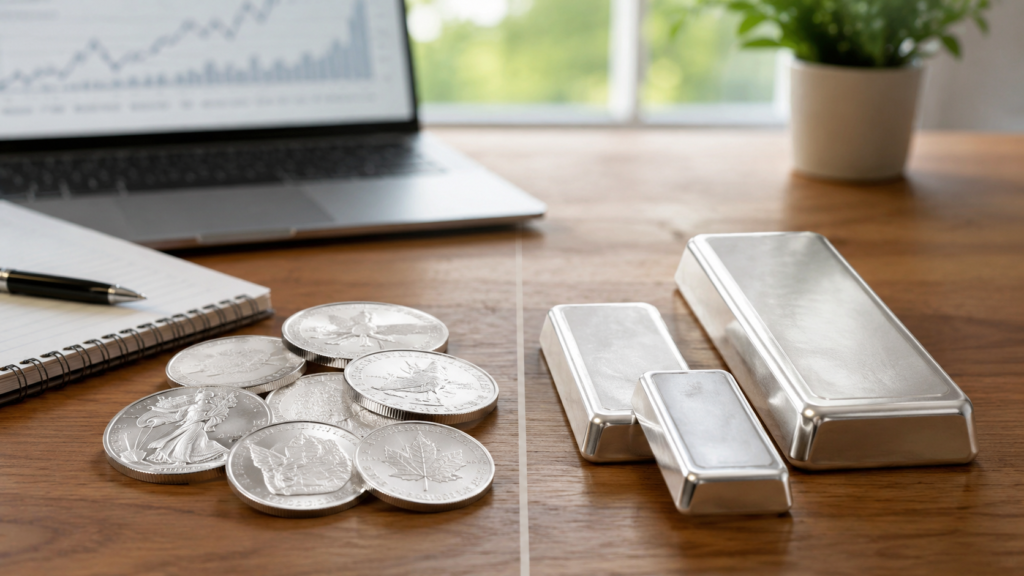
[IMAGE: silver-coins-vs-bars-investment-guide.png]
Alt text: Silver coins and silver bars on a desk for comparing investment options
Quick Answer: Silver Coins vs. Silver Bars
For most beginners:
- Start with silver coins
- Add silver bars later
- Avoid buying only based on the lowest price
- Focus on trusted products from reputable dealers
- Keep liquidity in mind from day one
Here is the simplest rule:
Coins are better for flexibility. Bars are better for efficiency.
That means coins are usually easier to sell in smaller amounts, while bars may help you accumulate more total silver at a lower cost per ounce.
Best beginner strategy
A practical beginner strategy might look like this:
- Start with widely recognized one-ounce silver coins.
- Learn how spot price and premiums work.
- Buy only from reputable dealers.
- Add ten-ounce bars later as your budget grows.
- Keep some silver in smaller pieces for flexibility.
That approach helps you avoid overthinking while still building a smart foundation.
What Are Silver Coins?
Silver coins are usually produced by government mints. Common examples include products like American Silver Eagles, Canadian Silver Maple Leafs, and other well-known sovereign bullion coins.
These coins often contain one troy ounce of silver and are widely recognized by dealers and investors.
Why investors like silver coins
Silver coins are popular because they are:
- Recognizable
- Easy to verify
- Easy to sell
- Convenient for beginners
- Trusted by many buyers
When you are new to silver, recognition matters. A buyer is generally more comfortable purchasing a familiar government-minted silver coin than an unknown private-mint product.
That trust can matter later when you want to sell.
What Are Silver Bars?
Silver bars are pieces of refined silver usually produced by private mints or refiners. They come in several sizes, including:
- 1 oz bars
- 5 oz bars
- 10 oz bars
- Kilo bars
- 100 oz bars
Bars are popular with investors who want to maximize the amount of silver they receive for each dollar spent.
Why investors like silver bars
Silver bars are attractive because they often have:
- Lower premiums than coins
- Simple storage
- Efficient stacking
- More silver per dollar
- Better value for larger purchases
The tradeoff is that bars may not be quite as liquid as widely recognized coins, especially in larger sizes.
Silver Coins: Pros and Cons
Pros of Silver Coins
1. Easier to sell
Silver coins are typically more liquid than bars. That means they may be easier to sell when you need cash or want to rebalance your holdings.
Recognizable coins are especially useful because dealers and private buyers already know what they are.
2. Better for beginners
Coins are simple to understand. Most popular bullion coins are one ounce, which makes price comparisons easier.
A beginner can quickly compare:
- Spot price
- Dealer premium
- Shipping cost
- Final cost per coin
That simplicity is valuable when you are still learning.
3. More trusted by buyers
Government-issued coins tend to carry strong trust because they come from official mints.
That does not mean they cannot be counterfeited, but it does mean buyers often feel more confident with them than with unknown bars or rounds.
4. Flexible to sell in small amounts
One of the biggest advantages of coins is flexibility.
If you own twenty one-ounce coins, you can sell one, five, or ten at a time.
If you own one large silver bar, selling part of it is not possible. You either sell the whole bar or keep it.
Cons of Silver Coins
1. Higher premiums
The biggest downside of coins is cost.
Silver coins usually cost more over spot price than bars. That extra cost is called the premium.
Premiums vary depending on demand, product type, dealer pricing, and market conditions.
2. Less silver for your money
Because coins often carry higher premiums, you may receive fewer total ounces compared to buying bars with the same budget.
For example, an investor focused only on total silver weight may prefer bars.
Silver Bars: Pros and Cons
Pros of Silver Bars
1. Lower cost per ounce
Silver bars often have lower premiums than coins, especially in larger sizes.
That means more of your money goes toward actual silver instead of product markup.
2. Efficient for larger purchases
Once your silver holdings grow, bars can become practical.
Ten-ounce bars are especially popular because they offer a balance between:
- Lower premiums
- Reasonable resale flexibility
- Easier storage
- Familiar sizing
3. Easy to store
Bars are simple to stack and organize.
For investors building a larger physical silver position, bars can be more space-efficient than piles of individual coins.
Cons of Silver Bars
1. Less flexible than coins
The larger the bar, the less flexible it becomes.
A 100-ounce silver bar may be efficient to buy, but it is not always convenient to sell. You may not want to liquidate that much silver at once.
2. More verification concerns
Bars may require more careful verification when selling, especially if they are from lesser-known refiners.
That does not mean bars are bad. It simply means the source matters.
3. Larger bars may limit your buyer pool
Not every buyer wants or can afford a large silver bar.
Smaller units are often easier to move because more buyers can afford them.
Silver Coins vs. Silver Bars: Key Differences
| Factor | Silver Coins | Silver Bars |
| Best for beginners | Excellent | Good |
| Premiums | Usually higher | Usually lower |
| Liquidity | Very strong | Good, depending on size |
| Flexibility | High | Lower with large bars |
| Storage efficiency | Good | Excellent |
| Recognition | Very strong | Depends on mint/refiner |
| Counterfeit concerns | Lower with trusted coins | Higher with unknown bars |
Which Is Better for a $500 Silver Starter Plan?
For someone starting with around $500, silver coins usually make more sense.
At that level, your first goal should not be squeezing every possible penny out of the premium.
Your first goal should be learning how to buy physical silver safely.
That means focusing on:
- Recognized products
- Reputable dealers
- Simple pricing
- Easy resale
- Avoiding fake or questionable listings
A beginner with $500 may be better served by buying a small number of recognized one-ounce coins than chasing the cheapest bar from an unknown seller.
A simple $500 approach
A basic starter approach could be:
- Buy several one-ounce silver coins
- Avoid rare or collectible coins at first
- Compare total cost, including shipping
- Save receipts and order confirmations
- Store silver securely at home
The goal is confidence, not complexity.
CTA PLACEHOLDER:
Start here: See the $500 Silver Starter Plan
Link later to: /500-silver-starter-plan/
When Do Silver Bars Make More Sense?
Silver bars start to make more sense when:
- You already understand premiums
- You are buying larger amounts
- You want to lower your average cost per ounce
- You have a storage plan
- You do not need maximum resale flexibility
A common next step is the ten-ounce silver bar.
Ten-ounce bars are popular because they are large enough to reduce premiums but not so large that they become difficult to sell.
For many investors, ten-ounce bars become a useful middle ground.
Coins First, Bars Later: A Balanced Strategy
For most people, the best strategy is not “coins only” or “bars only.”
A balanced physical silver position might include:
- One-ounce coins for liquidity
- Ten-ounce bars for cost efficiency
- A small amount of cash available for future opportunities
- A clear storage system
- A plan for where you would sell if needed
This gives you both flexibility and efficiency.
Example strategy
A beginner might start with coins for the first few purchases.
Then, after gaining confidence, they might begin adding ten-ounce bars.
Over time, the stack becomes more balanced:
- Coins for easy resale
- Bars for lower-cost accumulation
That is a practical approach for many long-term investors.
What About Silver Rounds?
Silver rounds are privately minted pieces that look similar to coins but are not legal-tender government coins.
They can sometimes offer lower premiums than government coins while still being available in one-ounce sizes.
However, beginners should be careful.
Rounds can be a good option, but recognition varies. A well-known private mint round may be easier to sell than an unknown design from an unknown source.
For beginners, government coins are usually simpler.
Premiums Matter, But Do Not Chase the Cheapest Silver
One of the biggest beginner mistakes is buying only because something is cheap.
Cheap silver is not always the best silver.
Before buying, compare:
- Spot price
- Product premium
- Shipping cost
- Dealer reputation
- Buyback policy
- Product recognition
The lowest advertised price may not be the best deal after fees, shipping, or resale difficulty.
CTA PLACEHOLDER:
Before you buy: Learn How to Buy Silver Safely
Link later to: /how-to-buy-silver-safely/
Counterfeit Risk: Coins vs. Bars
Counterfeit silver exists, and beginners should take it seriously.
Coins from major government mints are generally easier to verify because they have known dimensions, weights, and designs.
Bars can also be verified, but large bars or unknown brands may raise more questions when reselling.
To reduce risk:
- Buy from established dealers
- Avoid suspiciously cheap listings
- Be cautious with online marketplaces
- Learn basic weight and magnet tests
- Keep purchase records
The best protection is buying from reputable sources in the first place.
Storage: Does It Matter Which One You Buy?
Yes.
Silver is bulky compared to gold, which means storage becomes more important as your holdings grow.
Coins are easy to organize in tubes or cases.
Bars are easier to stack in a compact space.
For small amounts, home storage may be simple. For larger holdings, investors may consider:
- Home safes
- Bank safe deposit boxes
- Private vault storage
- Depository options
Storage is not just about hiding silver. It is about access, security, insurance, and peace of mind.
When Should You Consider Retirement-Grade Precious Metals?
Buying a few silver coins with personal savings is different from using precious metals inside a retirement strategy.
As your interest grows, you may eventually want to learn about:
- Gold IRAs
- Silver IRAs
- Self-directed IRAs
- IRS-approved precious metals
- Approved depository storage
- Retirement diversification
This is where a company like Augusta Precious Metals may become relevant.
Augusta is better positioned for investors exploring retirement-focused precious metals, not someone simply buying a few silver coins for the first time.
CTA PLACEHOLDER:
Retirement-focused next step: Request Augusta Precious Metals’ free Gold IRA guide
Link later to: [Augusta affiliate link]
Should Beginners Use Augusta Precious Metals?
For a beginner starting with $500, Augusta may not be the first stop.
A $500 beginner is usually trying to learn the basics of physical silver, compare coins and bars, and understand dealer pricing.
Augusta is more relevant for investors who are thinking about precious metals as part of a larger retirement strategy.
That could include someone who:
- Has retirement savings to diversify
- Wants education on gold and silver IRAs
- Is comparing precious metals IRA companies
- Wants help understanding rollover options
- Is considering a larger allocation to physical metals
So the better way to think about it is:
Use beginner silver guides to learn how physical metals work. Explore Augusta later when you are ready to understand retirement-focused precious metals options.
CTA PLACEHOLDER:
For larger retirement accounts: Compare retirement-grade precious metals options with Augusta Precious Metals
Link later to: [Augusta affiliate link]
Final Recommendation
For most beginners, silver coins are the better first purchase.
They are easier to understand, easier to sell, and more trusted by buyers.
Silver bars become attractive later because they can reduce your cost per ounce and help you build a larger position more efficiently.
The best overall answer is:
Start with silver coins. Add silver bars later. Use both strategically.
That approach gives you flexibility, liquidity, and long-term accumulation potential.
Frequently Asked Questions
Is it better to buy silver bars or silver coins for investment?
For beginners, silver coins are usually better because they are easier to recognize and sell. Silver bars may be better later for investors who want lower premiums and more ounces for their money.
Are silver bars cheaper than silver coins?
Usually, yes. Silver bars often have lower premiums over spot price, especially in larger sizes.
Are silver coins easier to sell?
Yes. Recognized silver coins are generally easier to sell because more buyers and dealers trust them.
What size silver bar is best for beginners?
A ten-ounce silver bar is often a practical choice once a beginner has already bought some coins and understands premiums.
Should I buy silver rounds instead of coins?
Silver rounds can be useful, but beginners should stick with well-known mints and reputable dealers. Government coins are usually simpler for a first purchase.
Is physical silver a good investment?
Physical silver can help diversify a portfolio, but prices can be volatile. It is best viewed as a long-term hard-asset allocation rather than a guaranteed profit strategy.
Should I buy silver before gold?
Many beginners start with silver because it has a lower entry cost. Gold can make sense later as your precious metals strategy grows.
Where should I buy silver?
Buy only from reputable dealers with clear pricing, transparent shipping costs, and a strong reputation. Avoid deals that seem too good to be true.
Bottom Line
Physical silver does not need to be complicated.
Start small.
Choose recognizable products.
Avoid questionable sellers.
Learn how premiums work.
Then build your position over time.
For most people, silver coins are the smart first step. Silver bars can become the efficient next step as your confidence and budget grow.